Here are my slides from the Inside Government event on Enhancing UK Graduate Employability. I've been ask to present a case study on Developing a Strategic Commitment to Achieve High Levels of Employability.
Showing posts with label employability. Show all posts
Showing posts with label employability. Show all posts
Wednesday, 24 June 2015

Tuesday, 28 May 2013
Employability Partnership Agreement
I'm working on the Employabilty Partnership Agreements that we plan to develop with each academic department over the summer ready for the start of the academic year. The idea is to present the student profile and destinations data, review activity in the previous year, in particular levels of student engagement with the Service (thanks to Target Connect), then activity for the coming and finally an action plan detailing timings, responsibilities, resources etc.
Clearly the agreements will develop as we discuss them with departments (and each will be slightly different, depending on the needs/context), but the screenshot below gives you an overview of my current thinking on the structure. What have I missed?
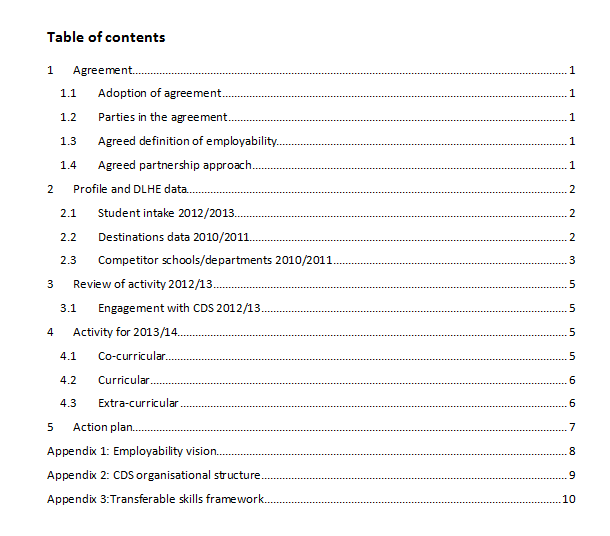
Clearly the agreements will develop as we discuss them with departments (and each will be slightly different, depending on the needs/context), but the screenshot below gives you an overview of my current thinking on the structure. What have I missed?
Tuesday, 18 December 2012
Tuesday, 26 June 2012
Draft open day talk
Friday, 8 June 2012
Employability strategy principles

Objective
To ensure our graduates have the extra dimension in order to make them the stand out choice for employers
Principles
- engage the majority of students as opposed to the current minority
- engage with students as early as possible in their undergraduate careers
- ensure students participate in one main intervention to avoid the current situation of a minority of keen students monopolising the places on the majority of interventions
- ensure that each intervention is accompanied by before and after support to ensure that students are appropriately prepared and effectively followed up
- make access to as many opportunities as possible a competitive process (to identify best candidates and simulate selection processes – those unsuccessful can be signposted to alternatives)
And possibly something about our minimum programme provision in years 1, 2 and 3.
It's a work in progress. Any comments?
Friday, 25 November 2011
Historical Studies alumni videos
Two weeks ago I popped up a quick post on Alumni talking heads experiment. I don't what to be too premature about this but it seems to have worked a treat! Of the 10 alumni contacts that Professor Roey Sweet (the Head of Department) and Professor Rob Colls (the Careers Tutor) gave me, five said yes to doing the video. And to my surprise - all of them actually did it! What's more it took very little chivvying from me. Some did webcam straight to YouTube (as I suggested after belatedly realising that was easiest), some used a digital camera and one even used his phone! Four of the five uploaded straight to YouTube and one uploaded to the DropBox folder I shared with them. Only one of the five videos needed significant editing (the one uploaded to DropBox in multiple files), the rest just required topping and tailing. Matt did a fantastic job of the editing in a couple of hours on Tuesday afternoon, and created this page.
 I'm really pleased with the end results. They're not broadcast quality but they are definitley good enough. The alumni did a great job on the content with very little guidance. They talked about how they got to their current role, a bit about what they do and some even offered a bit of advice at the end!
My next job is to try and get some conversation going on it round the department's Facebook page.

My next job is to try and get some conversation going on it round the department's Facebook page.
Thursday, 10 November 2011
Alumni talking heads experiment

The website will give you an overview of all this but what I'm focusing on at the moment is the alumni videos.
I contacted 10 Historical Studies alumni (via contacts from the department) a week or so ago and within a couple of days 5 had said 'yes' to recording a video for me. What surprised me was not just that half of them said 'yes' so quickly but also that they didn't really ask for technical help. The only information I gave them re the video itself was:
I’m hoping you might be able to help by recording a video clip stating who you are and when you studied at Leicester and how you got to the job you are now in. We would then edit the video and send it back to you for approval before posting it on the project website. Historical Studies finalists will then be able to see what some of their predecessors have been able to achieve since graduating, hopefully inspiring and motivating them and giving them some ideas. The video need be no longer than a couple of minutes and would need to be recorded via a webcam or digital camera. I can give you full instructions on how to record and then send us the video file.Since then though I've been thinking I should probably give them a bit more guidance. I had suggested uploading the file to a shared folder within Dropbox but I'm beginning to think that recording straight to YouTube via a webcam will be the best option (didn't know you could do that, d'oh!), rather than to go to the trouble of creating a file to then upload elsewhere. So, here's a quick Screenr on how to do it that I'll be sharing with the intrepid 5.
Obviously they'll need to create a YouTube account if they don't have one already, but they can share the file with me unlisted or privately. Also, recording straight from a webcam will probably ensure a nice still image, plus it should be easier to get sound and lighting right.
Am I missing anything? Any suggestions?
PS. More to follow on Boot Camp another time... (but any comments/suggestions on that also appreciated)
Friday, 28 October 2011
University Council presentation
This afternoon/evening I'm presenting to our University Council on 'Graduate employability'. I've got about 15 minutes to present the content and then there's an hour for questions and discussion. I have no idea what to expect. Below is the first part of the presentation, I've left out the last 6 slides which cover the sections 'our data' and 'our response' and the 'over to you' questions but I'm very happy to share these with any UoL staff if they want the full version. I'll let you know how it goes...
Tuesday, 19 July 2011
If these aren't employability skills I'll eat my hat
 |
| By pesbo |
Each undergraduate degree programme should enable development, in a discipline context, of a range of personal or transferable skills, including:
Which is all very well - but what's 'employability skills' doing at the bottom there? a) as an afterthought and b) as if it doesn't encompass all the items above it in the list? I think things have moved on since then but I think it's an interesting insight into how people sometimes perceive employability - as only to do with CVs and applications and interviews and not with the skills employers are looking for to do the job in the first place, like these.
- problem solving
- communication skills (written and oral)
- basic numeracy
- team working
- IT skills
- information handling skills
- emerging learning technologies skills
- lifelong learning skills
- employability skills
Any thoughts?
Friday, 10 June 2011
Being the one with their foot in the door

[...] this Employability Guide [...] explains the different competencies you need to join us. You might have developed many of them through your studies. Others could have come from part-time work or summer travel. Or from somewhere else altogether. What’s important is that you can recognise the skills we’re looking for, and then come up with a good example (or two) to show you’ve got them.Later on their Head of Strategy and Talent says:
Academic study gets your foot in the door; employability skills push it open to a far wider range of opportunities. They make your potential contribution to our business unique. Consider these skills and experiences your personal business card.What's really useful is that not only do they list the competencies they are looking for in any potential recruits, they also suggest where they might have been developed. So here are PwC's 10 Competencies and useful prompts to help potential recruits think about where they can find the evidence for these and identify any gaps.
| Competency | Prompts |
|---|---|
| Coach and develop yourself and others | Have you pushed yourself to achieve things that go above and beyond? Have you ever changed the way you did something after getting feedback? Have you taken the time to feedback to others? Have you had work experience or done voluntary work? Have you developed new skills outside of your degree? |
| Communicate with impact and empathy | Have you made something simple for others to follow? Have you used your powers of persuasion to get funding or agreement for a proposal? Have you presented on your course or to a club or society? Have you ever spoken in front of an audience? Have you written speeches, manifestos or business cases? Can you think of a time when you made a point of taking on board different opinions? |
| Be curious: learn, share and innovate | Have you used your initiative to achieve a goal? Have you made time to learn something new outside of your course? Do you go to events that are all about knowledge sharing or learning? Have you shared what you know with other people on your course? Have you ever come up with a new and better way of doing something? Have you been to employer presentations or skills sessions to explore your future career? |
| Lead and reinforce team success | Have you been adaptable in order to work better with others? Have you taken part in a voluntary project that relied on everyone pulling together? Do you belong to a sports team, club or society? Have you led a group? Can you think when you worked in a team to achieve a common goal? Do you know what qualities you can bring to a team? |
| Build and maintain relationships | Have you got to know your careers advisor or course tutor? Have you networked with people from other courses or universities? Did you get to know a customer really well? Have you built good relationships with others? Do you go to a club or society regularly, rather than once a year? Have you made (and maintained) useful contacts on a work experience placement? |
| Show you have courage and integrity | Can you think of a time when you worked well under pressure? Ever undertaken a mundane task with real enthusiasm? Do you always turn up on time? Do you put 100% into every application form? Have you handled conflicts or differences of opinion well? Have you kept your cool when dealing with a difficult customer? |
| Manage projects and money | Have you juggled different priorities to meet a deadline? Have you handled lots of different pieces of course work at the same time? Have you adapted positively to a new process at work? Have you ever put a backup plan into action? Have you looked after an organisation’s finances? |
| Be open minded, practical and quick to adapt | Have you taken on board suggestions from others? Have you picked up a shift at work at short notice? Have you been happy to stay late to get things done? Have you adapted to changes at work? Have you put yourself in a situation you’re not used to? Have you tried new things that are outside your comfort zone? |
| Build and use commercial and technical know-how | Have you looked into the kind of professional qualifications you might do with us? Have you thought about who your dream client would be or what it would be like to be a CEO? Have you gone the extra mile to understand how a company or industry operates? Do you take an interest in business and current affairs? Are you curious about what makes a business tick? Do you understand how your degree could make a difference to our business? |
| Caring about client service | Have you come up with ways to do things differently? Have you thought about how you can make a club or society better? Do you take a real interest in your parttime job, how the company works and who its competitors are? Have you looked into how PwC operates as a business? Do you work hard to make things better? Have you ever gone out of your way to do something positive for others? |
Table text (c) 2010 PricewaterhouseCoopers LPP
Of course not every graduate wants to work for a professional services company (thankfully) but many of the competencies do seem to be transferable. I'm wondering if a synthesis of these and the SHL competencies would be a useful framework to help us identify and develop employability in the curriculum. And I think the questions to prompt students to think about where they can find the evidence will be useful for students, departments and us as a careers service to help us to think more broadly and more strategically about what interventions are required.
What do you think?
Friday, 27 May 2011
Careers support from Corporate Services
One suggestion that came from the meeting on Wednesday was nothing to do with academic departments though but instead to do with the involvement of Corporate Services staff in supporting students. I'm not sure how many staff we have in Corporate Services at the University of Leicester but I do know they represent a wide range of professions (you can see a structure chart here), including:
- Finance
- Estates
- IT services
- Marketing
- Planning
- Human resources
- Conferencing
- Student support
- Legal services
Do you think this is an idea with legs? Are you or any other institution you know already doing it? What are the possible pitfalls? Just thinking out loud...
Thursday, 5 May 2011
Identifying employability in the curriculum
 |
| By andercismo |
Rich stumbled across the SHL Universal Competency Framework which identifies eight core competencies (they call them the 'great eight') that they say are crucial for good performance in the workplace. SHL define universal competencies as:
It is a single underlying construct framework that provides a rational, consistent and practical basis for the purpose of understanding people’s behaviours at work and the likelihood of being able to succeed in certain roles and in certain environments.I know very little about SHL other than they are a commercial company, and there may well be a better list of competencies somewhere, but they seem like a useful starting point for conversations about employability, and indeed learning development, in the curriculum. The eight competencies are:
- Leading and deciding
- Supporting and co-operating
- Interacting and presenting
- Analysing and interpreting
- Creating and conceptualising
- Organising and executing
- Adapting and coping
- Enterprising and performing
| Competency | Description |
|---|---|
| Leading and deciding | Takes control and exercises leadership. Initiates action, gives direction and takes responsibility. |
| Supporting and co-operating | Supports others and shows respect and positive regard for them in social situations. Puts people first, working effectively with individuals and teams, clients and staff. Behaves consistently with clear personal values that complement those of the organisation. |
| Interacting and presenting | Communicates and networks effectively. Successfully persuades and influences others. Relates to others in a confident and relaxed manner. |
| Analysing and interpreting | Shows evidence of clear analytical thinking. Gets to the heart of complex problems and issues. Applies own expertise effectively. Quickly learns new technology. Communicates well in writing. |
| Creating and conceptualising | Open to new ideas and experiences. Seeks out learning opportunities. Handles situations and problems with innovation and creativity. Thinks broadly and strategically. Supports and drives organisational change. |
| Organising and executing | Plans ahead and works in a systematic and organised way. Follows directions and procedures. Focuses on customer satisfaction and delivers a quality service or product to the agreed standards. |
| Adapting and coping | Adapts and responds well to change. Manages pressure effectively and copes with setbacks. |
| Enterprising and performing | Focuses on results and achieving personal work objectives. Works best when work is related closely to results and the impact of personal efforts is obvious. Shows an understanding of business, commerce and finance. Seeks opportunities for self-development and career advancement. |
So, for instance, a useful exploratory question when talking to an academic from a department could be: what are your students already doing in the curriculum that involves analytical thinking or solving complex problems, or learning new technology, or communicating in writing (Competency: analysing and interpreting)? Presumably quite a lot. Or how about what are they doing that involves planing ahead and working in a systematic and organised way, or following directions and procedures (Competency: Organising and executing). Some competencies will be easier to identify in the curriculum than others. For instance, 'Leading and deciding: takes control and exercises leadership. Initiates action, gives direction and takes responsibility.' This is probably easier to identify outside the curriculum, perhaps in involvement in clubs and societies, but even this one you could identify some elements of in lab work and fieldwork.
Clearly these competencies were written for a different context; the workplace. But if we need to identify how students are beginning to develop workplace skills then it seems like a good place to start. Once existing employability-related elements in the curriculum are identifying we could then work to supplement these with more traditional but contextualised careers skills. It would also help us when talking to employers to articulate our students' skills in a language they understand.
What do you think - are using competencies a good idea or not? What are the disadvantages? Have you tried it already? How will academics react? Is there a more appropriate set of competencies somewhere? Do you think the idea has legs? And if it has someone must have already done this somewhere else. As I'm new to this careers stuff I could do with some help.
Tuesday, 9 November 2010
Employability KPIs
 |
| Not CC (obvs) |
- Destination statistics
- Opportunities for career planning
- Support for the development of employability within courses
- Opportunities and support for work experience and placements
- Opportunities for developing employability outside the curriculum
- Engagement with employers
- External recognition and validation
I'd be interested in your comments, especially if you're from a careers service who's also wrestling with meaningful KPIs.
Subscribe to:
Posts (Atom)