Pages

Wednesday, 6 February 2013

about.me pages

I've been meaning to blog about this (and a lot of other things besides) for a while. If you've not yet got an about.me page I think you should. My first reaction when I saw it was "why would I need one of those?", but having used it for a while I think it's really useful. I've had mine for about a year now and I started putting it on my work signature about 6 months ago. I used to put my blog URL on my signature but since I've been blogging less that was looking a little redundant. I know colleagues that put their twitter address (bit risky) or their LinkedIn address (bit boring) on their signatures, but about.me seems like a good alternative. You can create a good looking page very easily (not that mine's great yet) pulling together all your social networks into one place. You can see mine here, and if I wasn't using a dynamic views template on Blogger I could embed it in this post or on a page or in the layout. There's a really good iPhone app too (hurry up with the Android one!).

I really like the way you can pull in loads of different pages into one space and get a really neat preview on the page (although does anyone else find that the Twitter and Blogger previews aren't quite up to date?). I've not added my Facebook page because it says "Adding Facebook will allow visitors to your about.me page to see all of your recent friends, photos, and status updates, even if they have limited access on Facebook". Which I don't want, but I have added Twitter, Blogger, Instagram, LinkedIn and Google+ (although you do need to be a bit careful about bringing everything together in one place).

I was reminded about all this yesterday when I (along with every other user on the planet) got an email update about them going independant again (AOL bought them out a few years ago) In the email they describe their commitment to be "the best personal identity service on the web", which they may well be.

Stuart Johnson
Deputy Director
Career Development Service
University of Leicester
www.le.ac.uk/careers
http://about.me/stujohnson


Friday, 1 February 2013

Systems thinking next steps

I feel like I'm going round in circles.

A quick brain dump following a couple of systems thinking meetings, including one with the Systems Thinking Intervention Manager and one with my boss and 4 other members of the team.
  • We've revised (and hopefully finalised, our purpose - "Help me get the graduate work or further study that I want" (the '"that I want" bit is quite brave - we might revisit that bit)
  • We need to think about data that we have to verify our assumption that students who engage with us early are more likely to gain graduate work or graduate study
  • As part of our demand capture we need to record actions taken and whether or not the demand was 'one stop', 'passed' on' or 'passed back'
  • We need to be careful that our codifying of data doesn't loose the richness and need to be particularly careful to ensure that demand is captured in the customer's own words (not our interpretation to fit our neat categories)
  • We need to look at the last 2 months of demand capture more carefully to infer what matters to customers and therefore determine what we should measure
  • We need to get the whole team on board with this
More to follow - I bet you're finding this fascinating

Wednesday, 30 January 2013

Systems thinking summary - check, plan, do

I've just found this helpful summary of what systems thinking is and I've copied and pasted it below. You can find the original on the University's system thinking pages, there are also some pages on containing information and resources from last week's Why systems thinking conference (that I blogged about here).

We've done 1 and 2 of check but there's still plenty more to (plan and) do...

Check

This involves the following stages:
  1. Identifying purpose of the system (e.g. admissions) from the student's perspective ('Make me a student')
  2. Analysing demand, e.g. value demand - 'I want to find out more about a course' and failure demand - 'I can't apply online', to identify what matters to the student
  3. Looking at our capability to respond to that demand
  4. Studying the flow of work; identifying value work and wasted work (e.g. duplication, handoffs)
  5. Identify what are the system conditions which prevent us from doing value work (e.g. process design, IT system, training)
  6. Look at the thinking behind the system conditions

Plan

This includes:
  1. Identifying the value steps (against what matters to a student)
  2. Identifying new operating principles and measures

Do

This involves an experiment. The team who did the check will take a small number of students out of the current system, and using the newly identified operating principles will try and test new ways of working, solving problems along the way. The experiment allows a clean flow of work to be established. More will be rolled into the experiment and tried and tested. The experiment allows us to be clear about what capacity is required for a new way of working, what resources, roles and structures. At this point decisions are made about further roll-in.

Saturday, 26 January 2013

Purpose

Systems thinking requires you to define the purpose of the service in the customers own words. Here's my attempt at refining our original stab.
"Advise and support me to develop the skills and experience I need to gain graduate work or study"

Update

We've now simplified the purpose to:
"Help me get the graduate work or further study that I want" 

Thursday, 24 January 2013

Quick reflections on yesterday's system's thinking conference

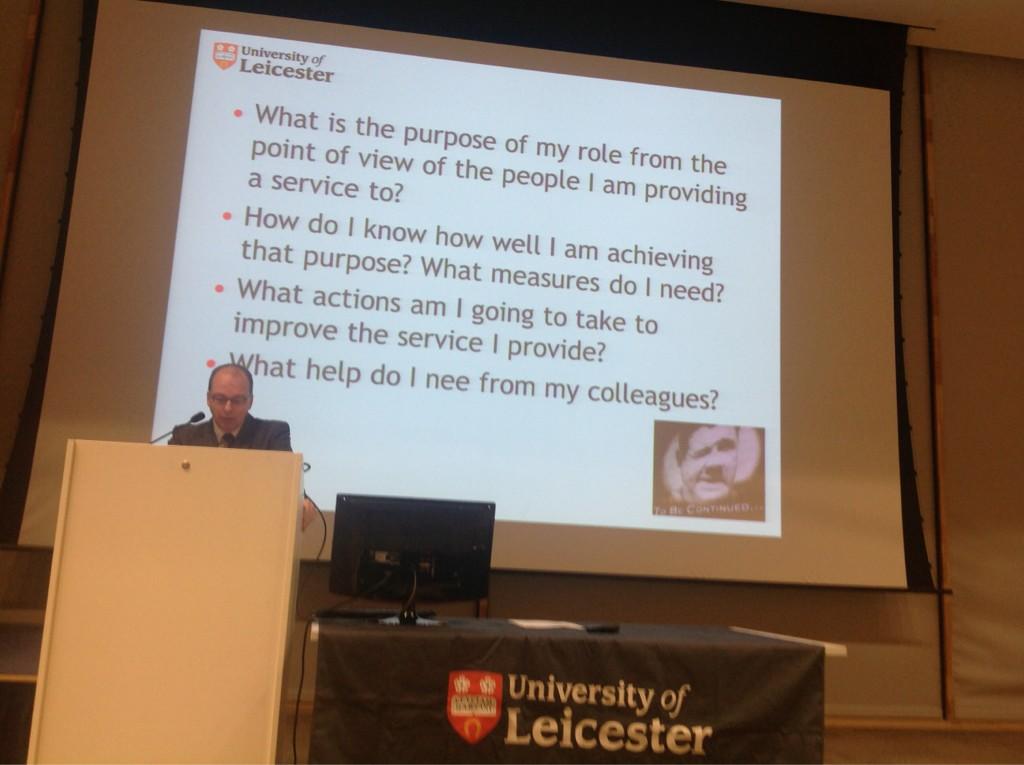
This is one of those 'notes to self' posts rather than something for the benefit of anyone else (although comments still very welcome). I really need to start to organise my thoughts more on systems thinking and I'd also like to get back into the blogging habit. So here are my quick reflections on the University of Leicester's Why systems thinking conference that took place yesterday, particularly in relation to what we need to in the Career Development Service.
  • We need to pull in systems thinking expertise (there are now two members of staff in Corporate Service whose roll is to act as internal consultants).
  • I think that our system is more complicated than the case studies I heard about in one of the sessions on distance learning (though I may be wrong). The case study involved a team of less than two FTEs, they were able to pull in a eight people for the initial 'check' stage over a six week period, and the flow seemed relatively simple (I enquire, I apply, I pay, I study, I graduate).
  • As a Service we need to devote more time to this (demand analysis in the hub has been running now since the end of November last year and is now begin recorded and categorised routinely). The next stages, I think, are to review the demand on a regular basis and also to establish what our 'flow' is.
  • We also need to re-establish our purpose in the customers own words and more precisely. Perhaps: "work with me to gain the advice, experience, skills and opportunities I need to gain a graduate job or graduate study" (something like that).
  • Resolve how employers and staff fit into the system.
  • Also need to figure out how to capture demand at all points of transaction, not just the hub (Unitemps, TARGETconnect, individual staff etc.).
  • Need regular and cumulative reviews of demand in order to identify what  is normal variation in the system and what are the genuine peaks that need addressing (need to be careful not to just tamper with the system).
And if we can do all that we'll be laughing! I think I might second myself to the project. And I really must finish reading that book!