I've been giving some thought lately to the purpose of careers services. I'm not claiming this is exhaustive or can't be improved on, and clearly it's an over-simplification, but here's a first stab. Fundamentally I think it's about generating a 'push' from students and a 'pull' from employers. I'm really interested in comments from students, employers and other careers service professionals (or anyone else for that matter).
Showing posts with label systems thinking. Show all posts
Showing posts with label systems thinking. Show all posts
Wednesday, 30 April 2014

Monday, 24 February 2014
Maybe we don't need a Careers Service website

After a meeting with Urfan and Ben from our web team on Friday I had the rather radical thought that perhaps we shouldn't have a Careers Service website at all. Let me explain...
Anyone who's give much thought to web architecture and user experience knows that the starting point for a site should never be the organisational structure but rather what the users of the site actually need/want from the service. So I mocked up a site on Google Sites (I might share it some other time) which I tried to base on user journeys rather than organisational structure, This got me thinking about things from an institutional perspective - in having a Careers Service website maybe I would just be doing the same thing at a different level i.e. creating a website around an organisational structure and so reinforcing organisational silos rather than thinking about things from the student persepctive. Instead of a Careers Service site perhaps we need a 'Help me get to where I want to be when I graduate' site, which is a lot broader and pulls in a much greater breadth of services and student experience (although clearly the name needs some work!).
Having said that, the Careers Service needs a profile and an identity in order to encourage student engagement with it, so I'm not sure I entirely agree ith myself; just thinking out loud.
I'd be interested in your thoughts though.
More to follow...
Thursday, 30 May 2013
Systems thinking report
Kim Smith has been working with us since the end of January on, amongst other things, our systems thinking project. Below is the Prezi she used at our team meeting yesterday to explain some of the findings and the key learning points.
Our systems thinking journey so far hasn't been straight forward (as I've expressed in a couple of previous posts, e.g. this one) but I think we are getting there (slowly). We are now focusing on a narrower aspect of what we do, so rather than looking at the whole system (the purpose of which we defined as 'help me get the graduate job or further study that I want') we are now focusing on the support we offer students in applying for jobs or study ('help me get to the next stage of the application process').
More to follow, but progress...
Friday, 15 March 2013
Systems thinking needs time
 |
| (Click for source) |
You should try to dedicate time to study the system
The more time you devote to study the quicker we get there. Because it’s about a different way of thinking you won’t get to the same place if you rely on other people to uncover and present back to you. Also consider who else you might want to co-opt to get involved (it’s always better to have staff closest to the work who understand how things really operate involved in the team).Be clear about when you’re studying and when you’re operational
This is best served by you blocking out time rather than having meetings to review progress. Also ties in with the first item about dedicating time to study.Don’t mix the two i.e. tamper whilst you’re studying
I understand the urge to improve based on what you find whilst you’re studying and I’m not saying that you mustn’t do this. However until you’ve been through the journey you may not know what is right to fix and what is knee jerk reaction. It is also harder to study a moving system, blurs the distinction between when you’re studying the system and when you’re operational and impedes what we want to get out of the systems thinking exercise (because systems thinking helps to develop a completely different and opposing way of thinking to a traditional approach and there’s no middle ground).Be clear about the system you’re studying and purpose of that system
Studying the Career Development Service as a whole with a purpose of ‘help me get the graduate job or further study that I want’ is fine. Excluding the Curriculum aspect to this to focus on the responsive side of what you do for the time being I think is fine and doesn’t change the purpose of the system. In fact it will give you clues as to how well the Curriculum programme is working.Make the learning that you are getting from this visible
Whilst we may want to re-jig some of we’re capturing making what we’re discovering visible on your wall is a positive development. If you want to tidy or re-jig any materials (or need to use your whiteboard again) then that’s fine but do keep the original content just in case…In terms of structuring the content you might want to think about:
- System description - ‘provision of responsive Careers Service offerings’
- Customers - Current student
- Purpose - ‘help me get the graduate job or further study that I want’
- Scope - describe anything we’re not looking at
- Demand Analysis - type and frequency of demand (by category), value/failure, resolution etc
- What Matters and Measures - description and data
- Flow (as and when) - we’ll worry about this later
- Current Operating Principles i.e. in the current system it is ok (or not ok) to…..
- Anecdotal Evidence - things people might have said etc
- Issues/things to look at - anything that crops up or things that occur to us that we should look at
- Learning – focus on the things that have surprised you
Good advice. Now all I need to do is do it...
Monday, 18 February 2013
I need some systems thinking advice

- establishing the purpose
- getting a clearer understanding of the steps involved
- feeling like we were going round in circles a bit (but also feeling like we were getting somewhere)
- getting frustrated but realising that we had to collect demand at all (or at least more) points of transaction not just the Hub
- the penny dropping about students modifying their behaviour to fit into our system
...I've hit a brick wall.
I mentioned in my very first systems thinking post that I thought that our system was more complicated than the case studies I heard about at the conference; now I'm convinced this is the case. The value steps of the distance learning administration case study (UoL login only) were "I enquire, I apply, I pay and register, I study, I am awarded and graduate" - but the support the Career Development Service provides to students doesn't fit into to a tidy little process. Perhaps I'll be proved wrong and after finally getting through 'Check' (it's taking us forever) we'll have a tidy little series of value steps, but I doubt it.
Systems thinking seems to lend itself to processes (see Who's using it? in UoL). At the conference the examples were definable processes; the breakout sessions were about expenses, maintenance and DL administration, and the keynote (UoL login only) was about selling insurance; but I don't think what we do can be boiled down to a process. Our 'process' is more akin to the 'I study' step of the DL administration example, i.e. a one to four year period where lots of stuff happens, much (most) of it requiring students to learn and develop independently, and that seems to me to be far too messy and unpredictable to be summarised in as a series of value steps. 'Help me get the graduate job or further study that I want' is always going to be more complicated than 'make me a student' or 'make me an employee'.
How far we can get with this depends on whether or not it will be worthwhile concentrating on just narrow aspects of our system, which we could then (potentially) patchwork together. This is what we had planned to do originally in order to keep things simple (starting with student appointments in the Hub) but then we realised that what was going on in the Hub couldn't be considered independently of what was going on elsewhere. I think it could work with our Leicester Award programmes because I imagine they can be boiled down to a relatively simple series of value steps similar to those identified for DL administration, but I'm struggling to see how we can pull this together across all our areas of our activity.
So I'm completely stuck. And I think the reason I'm stuck is that what we do isn't a simple process. I'm committed to getting this working but I'm struggling to get it any further unless we really narrow the focus.
Can anyone give me some advice? Or point me in the direction of some messier, non-process based case studies? What am I missing?
Can anyone give me some advice? Or point me in the direction of some messier, non-process based case studies? What am I missing?
Thursday, 14 February 2013
Are our students modifying their behaviour to fit our system?
 |
| Image by Ben Oh |
I had a systems thinking conversation with Kim yesterday and we both realised something. I blogged last week about the fact that we have been coding our demand data too early and so the help desk have been unintentionally squeezing demand data into our categories that the demand may not necessarily fit. For example, a student might come into The Hub and say "I'd like help with my CV" and we might hear this as (and categorise it as) "I want an appointment", which may not be what they actually want (they might just want a link to a web page that can help them or they may just want someone to check something quickly or it may be that the help desk can answer their query directly). This I got last week.
What I only got yesterday, however, is that students may actually be modifying their behaviour and language to fit with our systems. So they may come in and actually say "Can I have an appointment" because that's how they understand us to be set up to help them, when they might actually mean "I need help with an assessment centre that I have next week", which might be a demand that could be met by us via a workshop that we are running or a web page or a quick chat with someone - but not necessarily an appointment. We are therefore now recording the demand in more detail - not just in their own words (this bit we started doing last week) but checking what they actually mean by, for example, if they ask for an appointment asking them why they want one. Kim is then going to categorise the data from this before we have a meeting with the very helpful Systems Thinking Pete.
Friday, 8 February 2013
Frustration

- ID number
- date
- time
- method (face to face, email, phone)
- who (student, staff, employer)
- demand (verbatim - or as good as)
- our response
- whether this was us solving it, passing it on (to someone else) or passing it back (to the customer)
We've also realised we need to collect demand at all points of transaction simultaneously - previously we had hoped to keep things simple by getting the collection right in the Hub first and only then rolling it out to other parts of the Service. Instead we're now going to try and collect it in all parts of the Service at once, at least the ones that are customer (student) facing, so that's all staff involved in:
- the Hub
- appointments (guidance and feedback)
- experience related activity - volunteering, Leicester Award, internships, enterprise, internships and Unitemps
Other points of contact are the curriculum (although that's mostly staff contact) and employers (employer contact), so we're going to leave those be for a while. Also, given the pressures on the Service at the moment we're just going to start with volunteering and Leicester Award (although I haven't told them this yet!) - this will involve all staff in these teams collecting demand for a couple of weeks. Once this is done we'll sit down with our systems thinking colleague again and properly analyse the demand.
So it feels a bit like we're going round in circles but unless we get this beginning bit right we'll be working off skewed data. So far we're still on stage 2 of check - so plenty more still to do. I did ask when the frustration stops and it feels like we're making progress - there's no definitive answer to this but I hope it's soon! One thing that's obvious is that whilst we're not lacking enthusiasm (although, to be honest, that does wane occasionally) we are lacking expertise. In principle the approach is simple, but in practise its easy to get it wrong and end up barking up the wrong tree.
Onward and upward!
Friday, 1 February 2013
Systems thinking next steps

A quick brain dump following a couple of systems thinking meetings, including one with the Systems Thinking Intervention Manager and one with my boss and 4 other members of the team.
- We've revised (and hopefully finalised, our purpose - "Help me get the graduate work or further study that I want" (the '"that I want" bit is quite brave - we might revisit that bit)
- We need to think about data that we have to verify our assumption that students who engage with us early are more likely to gain graduate work or graduate study
- As part of our demand capture we need to record actions taken and whether or not the demand was 'one stop', 'passed' on' or 'passed back'
- We need to be careful that our codifying of data doesn't loose the richness and need to be particularly careful to ensure that demand is captured in the customer's own words (not our interpretation to fit our neat categories)
- We need to look at the last 2 months of demand capture more carefully to infer what matters to customers and therefore determine what we should measure
- We need to get the whole team on board with this
Wednesday, 30 January 2013
Systems thinking summary - check, plan, do
 I've just found this helpful summary of what systems thinking is and I've copied and pasted it below. You can find the original on the University's system thinking pages, there are also some pages on containing information and resources from last week's Why systems thinking conference (that I blogged about here).
We've done 1 and 2 of check but there's still plenty more to (plan and) do...
Check
This involves the following stages:- Identifying purpose of the system (e.g. admissions) from the student's perspective ('Make me a student')
- Analysing demand, e.g. value demand - 'I want to find out more about a course' and failure demand - 'I can't apply online', to identify what matters to the student
- Looking at our capability to respond to that demand
- Studying the flow of work; identifying value work and wasted work (e.g. duplication, handoffs)
- Identify what are the system conditions which prevent us from doing value work (e.g. process design, IT system, training)
- Look at the thinking behind the system conditions
Plan
This includes:- Identifying the value steps (against what matters to a student)
- Identifying new operating principles and measures
Do
This involves an experiment. The team who did the check will take a small number of students out of the current system, and using the newly identified operating principles will try and test new ways of working, solving problems along the way. The experiment allows a clean flow of work to be established. More will be rolled into the experiment and tried and tested. The experiment allows us to be clear about what capacity is required for a new way of working, what resources, roles and structures. At this point decisions are made about further roll-in.Saturday, 26 January 2013
Purpose

"Advise and support me to develop the skills and experience I need to gain graduate work or study"
Update
We've now simplified the purpose to:"Help me get the graduate work or further study that I want"
Thursday, 24 January 2013
Quick reflections on yesterday's system's thinking conference
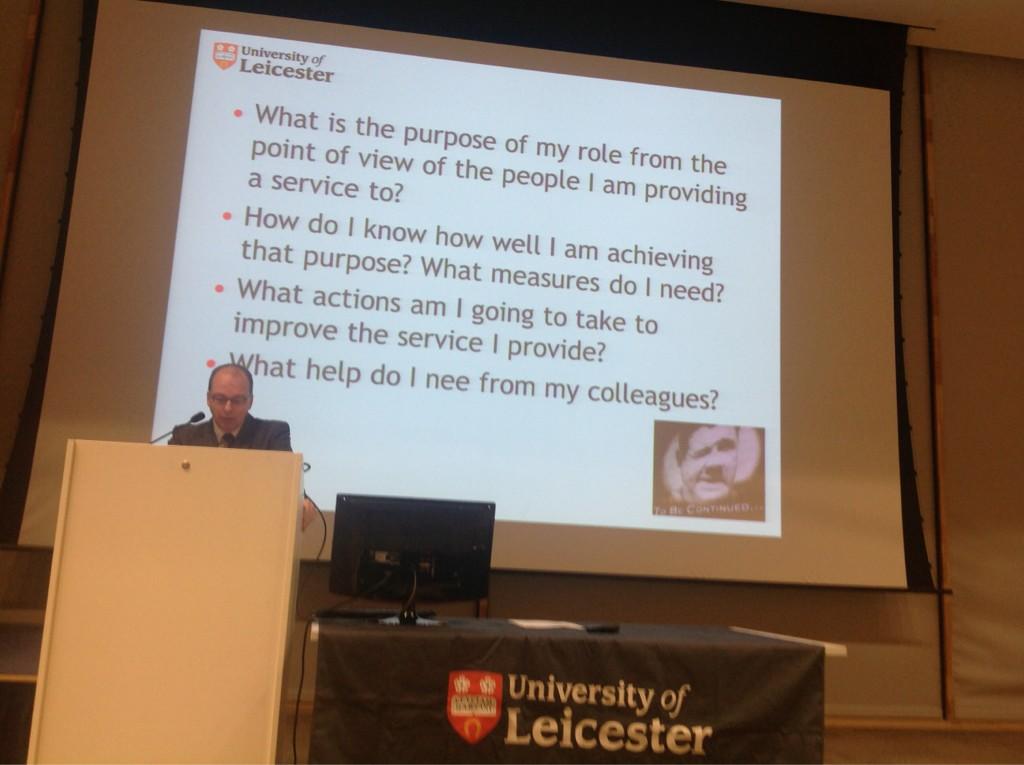
- We need to pull in systems thinking expertise (there are now two members of staff in Corporate Service whose roll is to act as internal consultants).
- I think that our system is more complicated than the case studies I heard about in one of the sessions on distance learning (though I may be wrong). The case study involved a team of less than two FTEs, they were able to pull in a eight people for the initial 'check' stage over a six week period, and the flow seemed relatively simple (I enquire, I apply, I pay, I study, I graduate).
- As a Service we need to devote more time to this (demand analysis in the hub has been running now since the end of November last year and is now begin recorded and categorised routinely). The next stages, I think, are to review the demand on a regular basis and also to establish what our 'flow' is.
- We also need to re-establish our purpose in the customers own words and more precisely. Perhaps: "work with me to gain the advice, experience, skills and opportunities I need to gain a graduate job or graduate study" (something like that).
- Resolve how employers and staff fit into the system.
- Also need to figure out how to capture demand at all points of transaction, not just the hub (Unitemps, TARGETconnect, individual staff etc.).
- Need regular and cumulative reviews of demand in order to identify what is normal variation in the system and what are the genuine peaks that need addressing (need to be careful not to just tamper with the system).
Subscribe to:
Posts (Atom)