Pages

Showing posts with label engagement. Show all posts

Wednesday, 15 January 2014

Health promotion as a model for engagement with careers

I'm sure people must have thought about this before (which is partly why I'm blogging about it) but I've been thinking in the last couple of days about the parallels between health promotion activity and engaging students with careers. The reason it came up is that a colleague mentioned the idea of a careers 'health check', which I think is a good idea, but my question is: why would students choose to engage with it?

GP practices often run 'well woman' or 'well man' clinics, but my guess is that the people who often go to these things probably aren't the ones who need it most, in fact they may be partly populated by the worried well.

Everyone in the higher education careers world knows that student engagement is a key issue and that doing it well is difficult, so can health promotion models help us to think about student engagement with careers?

Here are some quick observations re the parallels.

In both instances:

  • the challenge is to get people to do something that's good for them in the long run but might not have any immediate benefit in the short term
  • the process of doing something about it isn't easy, in fact it's hard work
  • people don't have to do it (so you only have carrots, not sticks)
  • nagging doesn't work (and according to the article linked below - neither does uncritical use of goal setting)
In throwing a few thoughts around about this in the last couple of days with Tristram Hooley on twitter, he pointed me in the direction of Jim Bright. Jim suggested searching for 'time discounting', which looks like a potentially useful avenue to pursue. Jim also directed me to a blog post of his on 'Goals Gone Wild: The Systematic Side Effects of Overprescribing Goal Setting'

So, has anyone given this any thought? Is there research out there already? What are health promotion models and can we adopt them?

As usual, just thinking out loud. Any comments or ideas much appreciated.

Monday, 11 February 2013

Leicester students starting their job search early

A colleague has just pointed out to me this article in The Telegraph from last month: Students look for jobs 'much earlier' in university career, based on Early Career Focus survey from graduate-jobs.com. The Telegraph article says:
The survey carried out by graduate-jobs.com found that more than one-in-five students at British universities now look for graduate jobs before their final year of university, in stark contrast with just one-in-20 in 2002. 
The article says that this is due to 2 reasons:
  1. Students are becoming more career-minded
  2. Top companies are approaching students earlier
And second on the list, with 56% of students starting their career search before final year is... University of Leicester, which is heartening.

We know that early engagement is key and we are putting in a lot of work to get students to start thinking about careers and employability from the first year. Perhaps it's beginning to pay off.

Thursday, 10 March 2011

HootSuite have finally caught up with me

Since blogging about our post-HootSuite options back in August I've been keeping a low profile on the subject.  That's because, admittedly rather sneakily, I realised that if I neither up-graded not went free then when I exceeded the 7 days grace period colleagues I'd registered as administrators for the accounts could still access it. I couldn't access it but that didn't matter because I'd devolved responsibility for the updates (although, rather pleasingly I was still able to access it via the iPhone ap). Anyway, as of 15 March Hootsuite are, quite rightly, closing that particular loop hole. My email from them read...
Hello Stuart Johnson,

We have you listed as the account owner of the "uolsd" profile on TWITTER on HootSuite. To ensure continued service, we require you to migrate to a current HootSuite plan. We're here to help and are emailing you to encourage you to take action and migrate your account.

For some background, since the new HootSuite plans were announced in August of last year, we grandfathered your account until November 2010, then provided a 7-day grace period to ensure time to decide on how you'd like to proceed. Further, our business sales team unsuccessfully attempted to contact your organization to provide assistance in choosing a plan. To continue using HootSuite, the listed owner of uolsd needs to sign-in to HootSuite [...] then migrate the account to a Pro plan or downgrade to the Basic (free) plan. Otherwise, we will disable HootSuite access to your social networks on March 15th.
Which is completely fair enough. So currently I've downgraded and have simply shared the password with colleagues. But this is very limited as it provides no workflow - which is the most useful aspect for us as it enables us to see who has replied to what. Also there are no analytics on the free account and they're useful too. So I need to think about whether we want to pay for their pro-plan - $5.99 per month for pro and then $15 per month per additional team member. Which is a considerable improvement on their original price plan - I wish I'd taken a screenshot at the time but I'm sure we were going to have to pay $99 per month which was simply prohibitive. Maybe they've listened to feedback from customers and come up with something more reasonable - or am I not remembering that correctly?

HootSuite certainly seem to have cornered the market. Of the options I blogged about back in August only MediaFunnel seemed like a goer for us but when we experimented with it we found it quite slow and limited (although it may have improved since then). With an reliable platform rich in useful features HootSuite have done an excellent job. What do you think? Should I upgrade? Or are there any other platforms out there that I don't know about?

Friday, 21 January 2011

Emerged technologies

Last Friday Marta and I went to the Association of Learning Development in Higher Education's CPD event in Leeds and ran a workshop on 'Using emerging technologies to engage students'. It was essentially a repeat of the Engaging without invading workshop that I did in March last year but a little bit updated.

The thing that was most interesting for me was the change in attitude of the audience from 10 months ago. It was a different audience but one drawn from the same professional group., the majority attitude last time had been 'I'm really not sure about this - convince me'; this time it was 'We really should be using this - how?' Also of note was an interest in using social media for learning as well as simply publicising (I need to get involved in Alan's Friendfeed project again).

I made the comment in the workshop that I wasn't sure how long we can continue to call these 'emerging technologies'. The feedback on the session was very positive but the one comment that jumped out was the one that said 'This wasn't a workshop on using emerging technologies it was a workshop on using Facebook and Twitter'. A lot changes in 10 months!

Thursday, 11 November 2010

I've got round the MailChimp problem

By Za3tOoOr!
You may have seen that I've been quite excited about MailChimp lately. My excitement subsided though after Vic pointed out last week that there was a problem with users subscribing from .le.ac.uk addresses. I hadn't noticed because the initial 3,500 subscribers (which I blogged about here) had come via a Plone form - and I simply imported the csv file into MailChimp. And because I was already included on this list via my .le.ac.uk address I tested the subsequent form with other addresses - hence missing the .le.ac.uk problem (school boy error).

I contacted our IT Services and they said that MailChimp wasn't blacklisted. I contacted MailChimp and they said that there must be some kind of filter which was blocking it. The answer in the end was to create a non .le.ac.uk address for the mail to be seen to be coming from so as to get through the spam filter which blocks messages that seem to be pretending to be from .le.ac.uk addresses but are coming from an external service. So I created a sdzhelpdesk@gmail address and set up an auto-forward on that to send all mail to sdzhelpdesk@le.ac.uk. I then made sdzhelpdesk@gmail the default "Reply-to" email in MailChimp and it works! Confirmations from .le.ac.uk address are now received and replies to messages are routed through gmail to .le.ac.uk.

I've tested it with three different people but if you would be willing to check for me (if you have a .le.ac.uk address) you can do so here. And as I said in my tweet, thanks to MattMailChimp and ITS for helping solve the problem. And to Vic for spotting it.

Now I can get on to the serious business of using it for student engagement.

Tuesday, 26 October 2010

MailChimp report

It's been just over a week since I sent my first MailChimp email to our distribution list of nearly 3,500. I blogged about it briefly but now that a week past since I sent it the report looks a bit more interesting.

Of the 3,456 messages sent 858 were opened, 136 bounced and 2,462 were unopened. To be honest I'm a bit disappointed about these figures - but they're pretty close to the industry average (apparently) and previously we didn't have any data on who had opened what so I'm going to use this as a base line.

What I'm more pleased about is the click rate.; 473 of the 848 who opened it clicked on a link - which suggest there was something of interest in it.

MailChimp even gives me a 'Click map' so I can see which links recipients clicked on. Very useful.

I also know from the report that the 848 people opened it a total of 1,285 times. 1,202 of the opens were from the UK, 47 from China, 4 from India and various single opens from other places.

Also, only 2 people unsubscribed. Which is good.

Now I need to decide what to do with all this lovely data. I've also figured out how to create subgroups within the list so we can differentiate on the basis of year of study (assuming people are happy to tell us this information). More on this later...

Wednesday, 20 October 2010

I've just decoupled the events feed

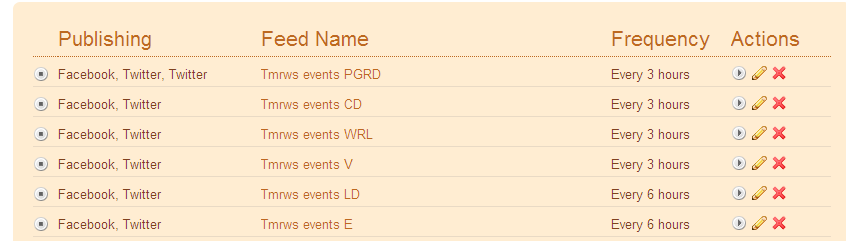
Having been quite pleased with myself a year ago for figuring out how to automate events notification from our website to Facebook and Twitter I've decided to turn it off. News items will continue to push out automatically but VicJames and I decided that the events notification was just too noisy. Vic is now taking more of a specific responsibility for updating our Facebook and Twitter accounts and it's a much better tone and timing than the automatic events feed (see this for an example). James is beginning to do the same for the postgraduate researcher development accounts. Would be interested to hear what you think...

Monday, 18 October 2010

MailChimp mail delivered

Got in this morning to a confirmation email that my first MailChimp mail had been delivered. See below.

The reason there were 3,456 on the list rather than more than 3,500 (the figure I mentioned last week) is because when you upload a list the very clever little chimp notices duplicates. It also notices syntax errors so I was able to alter an address which was to @g,mail.com and and one which was @hotmail.,com. Very clever.

Now I need to wait and then check out the reports when more data has arrived. The report about 20 minutes after the delivery said as follows...

Thursday, 14 October 2010

I’ve taken the plunge with MailChimp


Having mulled it over for a couple of days I've taken the plunge and become a fully paid up member of MailChimp. Having had more than 3,500 students sign up to our mailing list (yup, it surprised me too) I came to the conclusion that we couldn't manage such large numbers on an internal system. Doubtless I'll blog more about MailChimp when I've had more time to have test it, but just for now there are two features in particular that were clinchers for me.
  1. It puts users in control - they can unsubscribe or update their profile at any time
  2. It give email a social edge (no, really) by supporting Facebook page likes and adding sharing buttons
I thought I'd spotted a catch last night when I said thought they tied users in by not letting you export contact lists. I tweeted the thought and within two minutes I had a reply from MailChimp telling that I could export lists and with a link to the place telling me how. I was very impressed.

What I'm most concerned about now is what to say. Here's a link to a browser based draft and there's a screen shot of it below. If you have any comments on any aspect of the email (content, tone, style) then I'd be really grateful to hear them. I plan to send it tomorrow afternoon. Or maybe I should wait until Monday morning?

Tuesday, 12 October 2010

Mailing list managers

An update on the Good old fashioned email post - I've now had more than 3,000 people sign up to our mailing list. With that many people on the list I need a mailing list manager. Obviously I'd like to push more of them to our Facebook and Twitter accounts but as Marta said in the comments 'I guess we have to give them what they've signed up to'. They've asked for email. What I want to avoid though is having to reply to lots of emails - so we'll just use it as a channel to push information out - which is why I'd prefer it if they used social media because then the communication can be much more responsive. We can quickly reply to a tweet or a Facebook post and the one-to-many nature of social media means that everybody else can benefit from the answer. With email it's one-to-one and there's no way we're spending time responding to 3,000 questions, many of them probably similar.

So, does anyone know anything about mailing list managers? I think I need to learn about them quickly. We can't use our University CFS system for mailing to such large numbers easily because there's a limit of 1,000 people per email. Also, if we're going to use email then I want people to be able to unsubscribe easily should they want to, again, there's no easy way of doing this with CFS. A good mailing list manager should also give us several other useful features, including easy delivery, tracking and groups that support preferences.

I've heard of MailChimp and it looks good but we'd need to pay for it ($50 a month) because the free accounts are only for up to 1,000 addresses. It also has the potential to integrate with Facebook and Twitter.

Becka told me that they use Majordomo at Bradford. It describes itself as "a program which automates the management of Internet mailing lists. Commands are sent to Majordomo via electronic mail to handle all aspects of list maintenance. "

I've also stumbled across Mailman whic says "Mailman is free software for managing electronic mail discussion and e-newsletter lists. Mailman is integrated with the web, making it easy for users to manage their accounts and for list owners to administer their lists. Mailman supports built-in archiving, automatic bounce processing, content filtering, digest delivery, spam filters, and more."

I'm desperately in need of some advice from this from people who have used such things...

Thursday, 7 October 2010

Good old fashioned email


I've thought a lot about how we publicise our services in the last 12 months (for instance a couple of posts tagged publicity and all the Facebook stuff). I've thought about our website, social media, digital signage, email newsletters and print. All with a view to engaging students in what we do. More recently we've summarised our diverse range of services in some simple statements (I blogged about the first draft of those here), which have helped both staff as well as students understand more what we do and how it fits together. They're as follows:
  • Succeed in your studies
  • Gain experience
  • Develop your career
Incrementally we are getting more engagement, evidenced in part by the number of 'Likes' on our Facebook page (but I'm trying to get beyond likes). We've also been running a Student Development roadshow this week to get out and about on campus to tell students (and possibly staff) about what we do. In spite of all this activity I was still suspicious when I got in this morning to find more 1,800 emails in my roadshow signup subfolder. I asked on Twitter if anyone knew why it might be (I'd suspected David might have popped something up on the Students' Union Facebook page) but in the end I found out it was via a good old fashioned email from Paul Jackson, our Director (see below). It went to all students and we now have more than 2,300 responses since 17:46 yesterday (more than 500 of which were since having made the form University of Leicester login only).
So I've been musing about why this worked so well. I think there are a number of factors:
  • timing - I suspect people are more responsive to this kind of thing at the beginning of the academic year (especially freshers?)
  • tone - I think Paul struck a good tone in the email - supportive and friendly
  • simplicity - the email only asked students to do one thing 'click the link to receive important information'
  • clarity - I also think that the 'succeed in your studies, gain experience, develop your career' thing is nice and clear
  • incentive - there's a chance to win a £50 iTunes voucher if you sign up (as a University of Leicester student) - but I'd be surprised if that made a big difference
Now I need to do make sure that we capitalise on this initial interest. I also need to think about how to manage such big numbers. I'm certainly going to encourage people towards our Facebook and Twitter accounts, but maybe students just like good old fashioned email. I thought that was for old people.

Monday, 4 October 2010

Another quick Facebook ad update

I've just put up another Facebook ad. This time I've tried the following criteria:
  • who live in the United Kingdom
  • age 18 and older
  • who are at University of Leicester
  • who are connected to University of Leicester Students' Union
  • who are not already connected to Student Development, University of Leicester
The difference being the addition of the 'who are at University of Leicester' bit. I shyed away from this the first time in case people hadn't updated their profiles - but I'll give it a go and see what happens, especially as we're now in freshers' week more people should have updated their profiles by now. I really should put up another add with different criteria (as per Brendan's helpful comments to a previous post) but I want to see how this one goes. I'm only spending a poultry £5 per day but I still need to be careful what we spend on it whilst it's still very much experimental. I also asked David if he'd mention us on the Students' Union pages - which may well be more effective. And now I understand the 'Action' column in the stats summary table (thanks Alun) I should be able to differentiate between those who 'Like' us as a result of the ad and those who find us via other means (like a post David might put up). But the important thing in all of this is not the numbers but getting beyond likes. So more work to do...

Friday, 1 October 2010

Quick Facebook ad update

This needs to be quick as I'm in a hurry. Hopefully a more considered most will follow next week. So I mentioned on Tuesday that I'd put up my first Facebook ad. It was just a simple test with a very small budget of £20 - set to run over 4 days - 28 September to 1 October. The targeting was as follows:
  • who live in the United Kingdom
  • age 18 and older
  • who are connected to University of Leicester Students' Union (thanks David ;)
  • who are not already connected to Student Development, University of Leicester
On Tuesday before the ad we had 1,692 'Likes'. 4 days later we now have 1,728, an increase of 36. It's not a huge increase but it's something - and all in the week before term starts. You can see further details in the image below.

I need to go through the figures more closely (and look up the helps to see what some of the TLAs mean) but there have been 63 clicks but how many of those are responsible for the increase in 36 Likes I'm not sure. The ad performance glossary doesn't mention what the 'Actions' Column means - if the actions represent the number of clicks that translated to likes then the ad is responsible for less than a third of the increase in the four day period. Does anyone know what the Actions column means?
Anyway, I think I'll pop another one up for next week (but I'm going to try a different image) to see what impact that has. It's useful to be able to experiment...

Tuesday, 28 September 2010

First Facebook ad done

A couple of months ago I mentioned that I was thinking about a Facebook ad. Well, I've just created one. The comments on the previous post were very useful (thanks Brendan!). I've set a very small budget (£5 per day) just to test it out over the next four days. David very helpfully gave me temp admin permissions to the Students' Union page so I could target the ad at users who don't currently like the Student Development page (current "likes" 1,692) but already like the Students' Union page (current "likes" 5,163). I'll let you know how it goes. One thing I'll change for next time is the image - it doesn't render very well at a small size but I wanted to link it to our Roadshow - could probably update that now but need to get onto other things...

Monday, 12 July 2010

Thinking about a Facebook ad

I've been thinking that it might be a good idea to do a Facebook advert for our Student Development Facebook page during freshers' week. Having had a quick look at the guidance it looks like adverts can be very specifically targeted. There are three steps to putting one up:
  1. design your advert
  2. targeting
  3. campaigns pricing and scheduling
So I'm after advice, especially if you've used Facebook adverts before. My options under the three steps are as follows.

1. Design your advert

Facebook Content - that's easy, that will be the Student Development page.
Title - that will default to the name of the page.
Body text - the help text is helpful here.

Image - need something that's 'visible when small', the help text tells me.

2. Targeting

Location
Should I make this UK? The help text says 'Choose countries where your target users are located when they access Facebook.' So presumably this comes from their IP details rather than their profile information? I could also limit the 'City' to 'Leicester' - but I assume this would be too specific if Facebook draws this information from profile data?

Demographics
Age - I'll make this 18 years of age plus. The rest of the demographic information (gender, interested in, relationship and languages) I'm planning to leave unselected.

Likes and interests
I think I'll leave this blank.

Education and work
Education - this is where it gets tricky. I could choose 'At University' (see image, right) but the students I most want to reach may have not yet updated their profile and therefore still be listed as 'At Secondary School'. If I can assume everyone keeps an up to date profile though I could then choose 'At University' and then 'University of Leicester'

Workplaces - I plan to leave blank.

Connections on Facebook
Connections: Target users who are connected to: [Enter your page, event, group or application]. I was thinking of putting University of Leicester Students' Union Facebook page here but the help text says 'Leave this field blank unless you would like to narrow your audience to people connected to your Page, group or event.'.

Target users who are not already connected to: [Student Development, University of Leicester]

Friends of connections - I'll leave this unselected as the help text says the same as for 'Connections' (see above).

3. Campaigns, pricing and scheduling

This includes account currency, account time zone and campaign name, but more importantly the daily budget ('What is the most you want to spend per day?' and programme ('When do you want to start running your advert?'. And the more targeted the advert the cheaper the per click price. For instance, if the advert is very un-targeted the per click price is £0.70 but if I choose 'University of Leicester' in the Education bit the per click price halves - £0.35.

So, what do you suggest?

Monday, 21 June 2010

University of Bournemouth's First Year Experience Special Interest Group

I'm going down to the University of Bournemouth on Wednesday to talk to their First Year Experience Special Interest Group about our experience of using Facebook and Twitter to try to facilitate student engagement with student development issues. Here are my slides. You'll notice an uncanny resemblance to a previous presentation - but I have moved it on a bit with the Trying to get beyond likes thinking - and I'm hoping that in discussing it with the group in Bournemouth my thinking will be moved on a bit more. And while I'm on the train I'm going to read this paper, this paper and this paper - it's about time I read some papers on the subject (thanks to Michael Seery for the useful summary)!

Here I come sunny Bournemouth!

Thursday, 3 June 2010

Publicity channels

Part of my role in Student Development involves overseeing publicity. When I started in the role 18 months ago we were using only traditional forms of media to communicate with students; flyers, posters, emails and our website (all broadcast media that allow little or no two-way communication and simply pushes information to recipients). Since last summer I’ve been developing our networks on Facebook and Twitter (social media that does allow two-way communication and recipients select to ‘pull’ information towards themselves) to supplement the traditional methods. So we now have a range of publicity options available to us that I thought it would be helpful to outline – and if you have any suggestions or comments I’d be really pleased to hear them.

Website

Our website is our primary means of communication. I’m concious that we need to reorganise our front page (the subject of a future post) because we’re running out of space to put stuff, but that aside, here are elements I use within the site for publicity purposes.

News items (within Plone) are vital as they keep the website dynamic and also populate RSS feeds which I use to push out to Facebook and Twitter (see how here).

Event items also add a dynamic element to our site and populate RSS feeds in the same was as the news items do.

Top level portlets at the Student Development level of the website to highlight services that we want to give a particular push to at any given time. At the moment we’re doing this with our Graduate Success Programme (but we only have room to display one item like this at a time – which is one of the reasons we need to redesign the front page).

Team level portlets at the relevant team level – in the case of the Graduate Success Programme that’s in Career Development.

Mini sites to create an uncluttered site focussing on a particular event. In order to de-clutter an area I block the portlets above in the folder structure and start the navigation at the relevant level. If the event is to be a regular one Ialso request a specific URL, for example (again) www.le.ac.uk/graduatesuccess.

Social media

As already described I’ve been using social media to try and engage with students for some time now. More recently my focus has switched from Twitter to Facebook and in particular how to encourage interaction not just ‘Likes’. To this end I’ve been trying the following:

  • extra Facebook and Twitter updates (as per Helpdesk Hollie’s advice) in addition to our automated RSS outputs
  • a specific Facebook push – like we tried recently with Revision and exam skills (which seemed to work)

Digital signage

There are various plasma screens around campus which make up the University’s digital signage one of which is in the Student Development Zone. The screens generally operate on a 10 second cycle; scrolling through the notices set to display. The images and text displayed on these screens, therefore, have to convey information quickly and simply.

More important than our own screen (the traffic that it gets is limited given our location) are the other screens around campus – in particular in the Help Zone on the Ground floor of the Library, the Graduate School Reading Room, the Library Cafe and (especially) the screens in the Students’ Union.

Newsletters

Because not everyone looks at our website or joins our social media networks we also send out a monthly newsletter to all students. This comprises of just a few highlights plus a link to further highlights of the month’s news from our news feeds. Click here for the June edition.

Print

And for completeness I thought I should mention print. Although for publicity purposes we’re beginning to move away from print because it’s usually high cost for a relatively low impact.

Any suggestions? Have I missed anything?

Tuesday, 25 May 2010

Facebook page update

Recently I said I was feeling a bit behind the curve on Facebook pages so I've been thinking about it a lot lately including the other week when I put up a post Trying to get beyond 'Likes'.

I'm going to put a Like box in here - just because I can now ;)


Well, we've been trying a bit harder and we've been getting more interaction (more fans too, but it was interaction that we were after). During 10-14 May we tried to give a bit of a push on 'Exam time', Marta has been doing most of the work including:
Many of the items didn't yield much response but it did yield more than we normally get. It will take a while for us to learn what works and doesn't work but, importantly, it will also take a while for the culture of the page to change so people who like it will interact with it. Many people will want to use it just to receive updates, which is fine (and we'll never be as hip as the Students' Union), but if people want to interact they'll be more opportunity to do so.

Here's the page summary for the relevant week.
  • +24 fans this week (1,282 total fans)
  • 19 Wall posts, comments and likes this week (0 last week)
  • 932 visits to your page this week (543 visits last week)
And the pattern seems to be continuing, here's last week's stats:
  • +112 fans this week (1,394 total fans)
  • 9 Wall posts, comments and likes this week (19 last week)
  • 1,102 visits to your page this week (932 visits last week)
Which is an encouraging start.

Wednesday, 5 May 2010

Trying to get beyond 'Likes'

I've had two meetings recently where I've been able to glean some useful advice regarding Student Development's use of Facebook. The first was with David Morgan a couple of Friday's ago (after which I shared his really helpful social media guidelines) and the second with Alan Cann and Jennifer Jones last Friday. The meetings were different but the outcomes the same - a recognition that I need to encourage more interaction on our Student Development Facebook page.

I've been really pleased with the steady increase in the number of people who 'like' (Facebook's new language for what were page 'fans') our Facebook page but we need to do more with it. Currently the page updates are either automated via RSS feeds from our website or published manually by our Helpdesk via Hootsuite. This has provided a good foundation for the page but I'd like to begin to do more. Our Students' Union use their Facebook page really well and get a lot of engagement through it as a result. Three noteworthy differences in the set up of the pages are:
  1. they push out news updates from Facebook to Twitter whereas I've set the Student Development accounts to push out news updates from Twitter to Facebook;
  2. they put a Facebook like box very prominently on their website (ours is a bit squirreled away);
  3. they have at least 6 people set up as admins on their page whereas for Student Development it's just me.
In terms of the content they post the Students Union are very creative (in many ways more so than we could ever be) but they aren't just being creative for the sake of it, they are doing it to encourage interaction. To borrow again from David's social media guidelines they:
  • start conversations;
  • attach content - photos, videos and tagging (have a look at this video about an office move);
  • announce, remind and excite (whilst trying not to annoy);
  • think carefully about timing;
  • remember that followers can just turn them off.
So, I've decided to experiment with a bit of a push on revision and exam skills next week sometime. Currently we tend to just push links to relevant study guides but I think we need to do more to engage people so I'm thinking of the following:
  • embed our Revision and exam - top ten tips in the Facebook page (rather than just ink to it);
  • ask people for their own top revision tips;
  • give more staff in Student Development admin rights on the page so we can reply to comments more promptly;
  • link to other relevant content, including our workshops and consultations, accordingly;
  • and in all of this try not to annoy people by going on about stuff too much.
That doesn't look like much of a plan. What do you suggest?

Friday, 23 April 2010

Friday Facebook fink

I've been feeling a bit behind the curve with Facebook pages lately (even though I've thought quite a lot about them in the past six months). I'm aware that there have been several significant changes to pages in the last week or so but I just haven't had chance to read up on them. It's interesting to watch it slowly become more friendfeed-like since they acquired it.

I've been really pleased with how our Student Development page has continued to grow and I've been beginning to think I should be doing more with it than just pushing RSS into it from our website and getting our helpdesk to post to it via Hootsuite. We are beginning to see more interactions but I'd like to think about how to encourage these more. So I'm looking forward to seeing David Morgan again this afternoon, who set up www.facebook.com/StudentsUnion (I wish I'd been quick enough to grab a decent page name) to chat through some ideas. What a nice way to spend an hour on a Fridat afternoon :)