"The problem with Facebook is that it's keeping things from you."Thanks to Alan Cann for sharing this intelligently produced and extremely helpful video by Mike Elgan. 7 minutes well spent...
Showing posts with label facebook. Show all posts
Showing posts with label facebook. Show all posts
Monday, 20 January 2014
The problem with Facebook

Friday, 6 May 2011
Subtitle
Further to the change of name thing I think we're going to go for

I'm sure you'll all sleep more soundly in your beds knowing that. Thanks for the comments to the original post, especially from Vic and Zara. Now all I need to do is think about how and where to roll out the change, especially do I rename our Twitter account and what about the Facebook page (can't rename that and currently >2,100 likes)?

I'm sure you'll all sleep more soundly in your beds knowing that. Thanks for the comments to the original post, especially from Vic and Zara. Now all I need to do is think about how and where to roll out the change, especially do I rename our Twitter account and what about the Facebook page (can't rename that and currently >2,100 likes)?
Thursday, 10 March 2011
HootSuite have finally caught up with me

Hello Stuart Johnson,
We have you listed as the account owner of the "uolsd" profile on TWITTER on HootSuite. To ensure continued service, we require you to migrate to a current HootSuite plan. We're here to help and are emailing you to encourage you to take action and migrate your account.
For some background, since the new HootSuite plans were announced in August of last year, we grandfathered your account until November 2010, then provided a 7-day grace period to ensure time to decide on how you'd like to proceed. Further, our business sales team unsuccessfully attempted to contact your organization to provide assistance in choosing a plan. To continue using HootSuite, the listed owner of uolsd needs to sign-in to HootSuite [...] then migrate the account to a Pro plan or downgrade to the Basic (free) plan. Otherwise, we will disable HootSuite access to your social networks on March 15th.

HootSuite certainly seem to have cornered the market. Of the options I blogged about back in August only MediaFunnel seemed like a goer for us but when we experimented with it we found it quite slow and limited (although it may have improved since then). With an reliable platform rich in useful features HootSuite have done an excellent job. What do you think? Should I upgrade? Or are there any other platforms out there that I don't know about?
Friday, 21 January 2011
Emerged technologies
The thing that was most interesting for me was the change in attitude of the audience from 10 months ago. It was a different audience but one drawn from the same professional group., the majority attitude last time had been 'I'm really not sure about this - convince me'; this time it was 'We really should be using this - how?' Also of note was an interest in using social media for learning as well as simply publicising (I need to get involved in Alan's Friendfeed project again).
I made the comment in the workshop that I wasn't sure how long we can continue to call these 'emerging technologies'. The feedback on the session was very positive but the one comment that jumped out was the one that said 'This wasn't a workshop on using emerging technologies it was a workshop on using Facebook and Twitter'. A lot changes in 10 months!
Wednesday, 20 October 2010
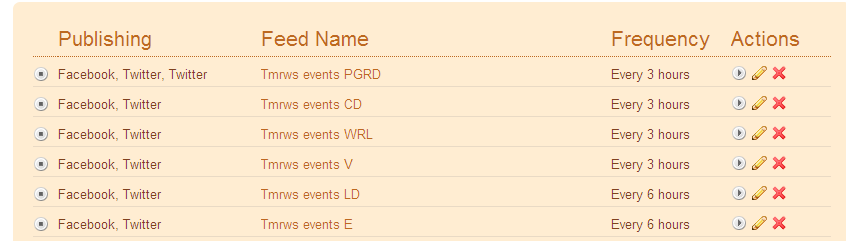
I've just decoupled the events feed
Having been quite pleased with myself a year ago for figuring out how to automate events notification from our website to Facebook and Twitter I've decided to turn it off. News items will continue to push out automatically but Vic, James and I decided that the events notification was just too noisy. Vic is now taking more of a specific responsibility for updating our Facebook and Twitter accounts and it's a much better tone and timing than the automatic events feed (see this for an example). James is beginning to do the same for the postgraduate researcher development accounts. Would be interested to hear what you think...
Tuesday, 12 October 2010
Mailing list managers

So, does anyone know anything about mailing list managers? I think I need to learn about them quickly. We can't use our University CFS system for mailing to such large numbers easily because there's a limit of 1,000 people per email. Also, if we're going to use email then I want people to be able to unsubscribe easily should they want to, again, there's no easy way of doing this with CFS. A good mailing list manager should also give us several other useful features, including easy delivery, tracking and groups that support preferences.
I've heard of MailChimp and it looks good but we'd need to pay for it ($50 a month) because the free accounts are only for up to 1,000 addresses. It also has the potential to integrate with Facebook and Twitter.
Becka told me that they use Majordomo at Bradford. It describes itself as "a program which automates the management of Internet mailing lists. Commands are sent to Majordomo via electronic mail to handle all aspects of list maintenance. "
I've also stumbled across Mailman whic says "Mailman is free software for managing electronic mail discussion and e-newsletter lists. Mailman is integrated with the web, making it easy for users to manage their accounts and for list owners to administer their lists. Mailman supports built-in archiving, automatic bounce processing, content filtering, digest delivery, spam filters, and more."
I'm desperately in need of some advice from this from people who have used such things...
Monday, 4 October 2010
Another quick Facebook ad update

- who live in the United Kingdom
- age 18 and older
- who are at University of Leicester
- who are connected to University of Leicester Students' Union
- who are not already connected to Student Development, University of Leicester
Friday, 1 October 2010
Quick Facebook ad update

- who live in the United Kingdom
- age 18 and older
- who are connected to University of Leicester Students' Union (thanks David ;)
- who are not already connected to Student Development, University of Leicester
I need to go through the figures more closely (and look up the helps to see what some of the TLAs mean) but there have been 63 clicks but how many of those are responsible for the increase in 36 Likes I'm not sure. The ad performance glossary doesn't mention what the 'Actions' Column means - if the actions represent the number of clicks that translated to likes then the ad is responsible for less than a third of the increase in the four day period. Does anyone know what the Actions column means?

Tuesday, 28 September 2010
First Facebook ad done
Monday, 23 August 2010
Our post-hootsuite options

Alan pointed out this helpful article to me on Top 5 alternatives to Hootsuite, which suggests the following:
You'll notice, if you scroll down the comments in that link that someone also suggested MediaFunnel.
There are a number of things I need a service to allow me to do, the main criteria are as follows:
- Support multiple Twitter accounts
- Support Facebook pages
- Allow multiple users to post to the accounts
- Shorten URLs
- Allow scheduled posts
- Allow attachments (especially images)
- Have a reasonable charging model

- I gave up with Brizzly because it kept asking me if I wanted to 'create a picnic'. Very annoying!
- Buzzom will be including a URL shortener soon - see. Also see comment on this post from the Deep Sherchan from the Buzzom team re premium version.
- MediaFunnel will be going Freemium but I'm assured there will be no bad surprises. Rumour has it it will be two users and two social media accounts for free., then each additional user/channel pack will be $4.95/month. This is much more realistic than Hootsuite.
So we'll be trying out MediaFunnel in the next few weeks and I'll let you know how we get on. So far it's looking extremely promising :)
Thursday, 12 August 2010
Thinking about Hootsuite alternatives
Today Hootsuite announced a freemium plan. I understand the need for a freemium model and Student Development already have a subscription with Flickr, however Hootsuite's price plan looks like it's going to be prohibitive for us.
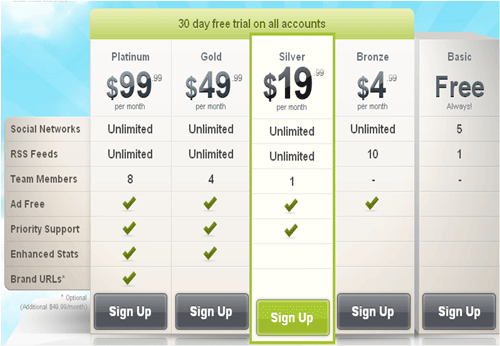
Hootsuite has been brilliant for us in the following ways:
Hootsuite has been brilliant for us in the following ways:
- team collaboration - allowing us to have lots of people (currently we have 6) posting to multiple accounts, especially our Student Development Facebook and Twitter accounts
- monitoring response and progress - this is a really handy feature, especially when we have so many people posting to the accounts - it helps us keep track of who's responded to what
- statistics - the stats give us a really useful snap shot - daily clicks, referral data and, most helpfully, most popular tweets
- scheduled posts - great for delaying posts to more appropriate times
- assign tasks - we can even assign responses to individual team members - but we haven't used this feature much yet
Monday, 12 July 2010
Thinking about a Facebook ad

- design your advert
- targeting
- campaigns pricing and scheduling
1. Design your advert
Facebook Content - that's easy, that will be the Student Development page.Title - that will default to the name of the page.
Body text - the help text is helpful here.

Image - need something that's 'visible when small', the help text tells me.
2. Targeting
LocationShould I make this UK? The help text says 'Choose countries where your target users are located when they access Facebook.' So presumably this comes from their IP details rather than their profile information? I could also limit the 'City' to 'Leicester' - but I assume this would be too specific if Facebook draws this information from profile data?
Demographics
Age - I'll make this 18 years of age plus. The rest of the demographic information (gender, interested in, relationship and languages) I'm planning to leave unselected.
Likes and interests
I think I'll leave this blank.
Education and work

Workplaces - I plan to leave blank.
Connections on Facebook
Connections: Target users who are connected to: [Enter your page, event, group or application]. I was thinking of putting University of Leicester Students' Union Facebook page here but the help text says 'Leave this field blank unless you would like to narrow your audience to people connected to your Page, group or event.'.
Target users who are not already connected to: [Student Development, University of Leicester]
Friends of connections - I'll leave this unselected as the help text says the same as for 'Connections' (see above).
3. Campaigns, pricing and scheduling
This includes account currency, account time zone and campaign name, but more importantly the daily budget ('What is the most you want to spend per day?' and programme ('When do you want to start running your advert?'. And the more targeted the advert the cheaper the per click price. For instance, if the advert is very un-targeted the per click price is £0.70 but if I choose 'University of Leicester' in the Education bit the per click price halves - £0.35.So, what do you suggest?
Monday, 21 June 2010
University of Bournemouth's First Year Experience Special Interest Group

Here I come sunny Bournemouth!
Thursday, 3 June 2010
Publicity channels
Part of my role in Student Development involves overseeing publicity. When I started in the role 18 months ago we were using only traditional forms of media to communicate with students; flyers, posters, emails and our website (all broadcast media that allow little or no two-way communication and simply pushes information to recipients). Since last summer I’ve been developing our networks on Facebook and Twitter (social media that does allow two-way communication and recipients select to ‘pull’ information towards themselves) to supplement the traditional methods. So we now have a range of publicity options available to us that I thought it would be helpful to outline – and if you have any suggestions or comments I’d be really pleased to hear them.
 Our website is our primary means of communication. I’m concious that we need to reorganise our front page (the subject of a future post) because we’re running out of space to put stuff, but that aside, here are elements I use within the site for publicity purposes.
News items (within Plone) are vital as they keep the website dynamic and also populate RSS feeds which I use to push out to Facebook and Twitter (see how here).
Event items also add a dynamic element to our site and populate RSS feeds in the same was as the news items do.
Top level portlets at the Student Development level of the website to highlight services that we want to give a particular push to at any given time. At the moment we’re doing this with our Graduate Success Programme (but we only have room to display one item like this at a time – which is one of the reasons we need to redesign the front page).
Team level portlets at the relevant team level – in the case of the Graduate Success Programme that’s in Career Development.
Mini sites to create an uncluttered site focussing on a particular event. In order to de-clutter an area I block the portlets above in the folder structure and start the navigation at the relevant level. If the event is to be a regular one Ialso request a specific URL, for example (again) www.le.ac.uk/graduatesuccess.
 As already described I’ve been using social media to try and engage with students for some time now. More recently my focus has switched from Twitter to Facebook and in particular how to encourage interaction not just ‘Likes’. To this end I’ve been trying the following:
 There are various plasma screens around campus which make up the University’s digital signage one of which is in the Student Development Zone. The screens generally operate on a 10 second cycle; scrolling through the notices set to display. The images and text displayed on these screens, therefore, have to convey information quickly and simply.
More important than our own screen (the traffic that it gets is limited given our location) are the other screens around campus – in particular in the Help Zone on the Ground floor of the Library, the Graduate School Reading Room, the Library Cafe and (especially) the screens in the Students’ Union.
Print
And for completeness I thought I should mention print. Although for publicity purposes we’re beginning to move away from print because it’s usually high cost for a relatively low impact.
Any suggestions? Have I missed anything?
Website
News items (within Plone) are vital as they keep the website dynamic and also populate RSS feeds which I use to push out to Facebook and Twitter (see how here).
Event items also add a dynamic element to our site and populate RSS feeds in the same was as the news items do.
Top level portlets at the Student Development level of the website to highlight services that we want to give a particular push to at any given time. At the moment we’re doing this with our Graduate Success Programme (but we only have room to display one item like this at a time – which is one of the reasons we need to redesign the front page).
Team level portlets at the relevant team level – in the case of the Graduate Success Programme that’s in Career Development.
Mini sites to create an uncluttered site focussing on a particular event. In order to de-clutter an area I block the portlets above in the folder structure and start the navigation at the relevant level. If the event is to be a regular one Ialso request a specific URL, for example (again) www.le.ac.uk/graduatesuccess.
Social media
- extra Facebook and Twitter updates (as per Helpdesk Hollie’s advice) in addition to our automated RSS outputs
- a specific Facebook push – like we tried recently with Revision and exam skills (which seemed to work)
Digital signage
More important than our own screen (the traffic that it gets is limited given our location) are the other screens around campus – in particular in the Help Zone on the Ground floor of the Library, the Graduate School Reading Room, the Library Cafe and (especially) the screens in the Students’ Union.
Newsletters
Because not everyone looks at our website or joins our social media networks we also send out a monthly newsletter to all students. This comprises of just a few highlights plus a link to further highlights of the month’s news from our news feeds. Click here for the June edition.Any suggestions? Have I missed anything?
Tuesday, 25 May 2010
Facebook page update

I'm going to put a Like box in here - just because I can now ;)
Well, we've been trying a bit harder and we've been getting more interaction (more fans too, but it was interaction that we were after). During 10-14 May we tried to give a bit of a push on 'Exam time', Marta has been doing most of the work including:
- a photo album on revision and exam tips
- some wall photos on the theme
- events related to workshops we've been running
- a poll on revision tips
- more focussed wall posts on the theme
Here's the page summary for the relevant week.
- +24 fans this week (1,282 total fans)
- 19 Wall posts, comments and likes this week (0 last week)
- 932 visits to your page this week (543 visits last week)
- +112 fans this week (1,394 total fans)
- 9 Wall posts, comments and likes this week (19 last week)
- 1,102 visits to your page this week (932 visits last week)
Thursday, 20 May 2010
Developments I'd like to see in Plone

I'm not a techie, but I have been using Plone now for more than four years so I know it pretty well from a user's perspective. Whilst there's no such thing as a perfect system I really like Plone and the ethos behind it, I especially like the flexibility of the sharing permissions that it gives us. The web team here at Leicester have done a great job in setting it up and supporting it with very limited resources (and for the record, they should get more).
So, here are some of the developments I'd like to see in the future (apologies in advance if I'm making any techie faux pas).
Selectively cascading portlets

Thumbnail images from news items into Facebook
I've set up news items to push out to Twitter and Facebook using the RSS and Twitterfeed (see this post for the Twitterfeed set up). What would be nice though would be if Plone could take a thumbnail of an image attached to a news item and put that in the Facebook post. Currently it doesn't do this so all our automated posts look very similar (look for the posts that come from Twitterfeed on our Facebook page)
NOT statement in collection fields
Within the Title and Description fields in collections it would be really useful if it allowed more logical statements. At the moment you can have AND and OR but not NOT. And NOT would allow more flexibility.More flexibility in the start date field in collections

- Item type = event
- Location = (relevant folder + search sub-folders)
- State = published
- Start date = 1 day, in the future, on the day
I've just looked at the criteria again and it looks like I should just be able change the 'which day' field to 2 days or 5 days or a week. That looks like it should solve my problem but I think I tried that before and it didn't work. I set it up more than six months ago though so I can't remember. I'll have another check but if anyone can tell me so I don't have to check that would be great :)
Bookmarklets
I understand there's an addon for bookmarklets (share on Twitter, Delicous, Facebook etc) but it conflicts with the feed mixer portlet. It would be good to get this fixed.Editor bugs
I prefer the TinyMCE editor to Kupu, on the whole, but there's a bug in TinyMCE which means that if you add a link to an image in a portlet the image dissapears (but works fine with Kupu editor).I've probably got some other suggestions but I'll just throw those out as a starter. It's not meant to be critical - just suggestions from an avid user.
Tuesday, 18 May 2010
The automated feeds are working
I've just realised that if you edit a news item in Plone that's already published and then save the changes it acts like a newly published item. How do I know this interesting piece of information, I hear you cry? Well, it's funny you should ask that...
 Yesterday I was showing a colleague how to create a collection in Plone that would pull in not only the news items that she published in her area of the website but also appropriate news items that others published elsewhere in the Student Development website. So in order to demonstrate this I went to a relevant news item and categorized it (that's what Plone calls it but most people will call this 'tagging') and then saved the changes. The collection item was set up appropriately to display item type (="news item"), location (=http://www2.le.ac.uk/offices/ssds/sd), categories (="Leicester Award") and state (="published") - so the item was fed into the collection accordingly. However, it wasn't until I was on Twitter a few minutes later that I realised that adding a category to a news item (or presumably any kind of editing) and then saving the changes causes the item to be re-published. Not only did the news item appear in my colleague's collection it also re-appeared:


- at the top of the Volunteering team's latest news feed
- at the top of the Student Development latest news feed
- at the top of the news portlets on every page in the above two sections
- and on Facebook
- and on Twitter
The problem was the story was six months old! So we quickly added a sentence to the bottom of the news item to say "The deadline for completion of this year's programme has already passed, but you can register now for the 2010/11 programme."
As my colleague said "It's all good publicity". And at least I know all the feeds are working. Thanks for the retweets!
Thursday, 13 May 2010
Image suggestions outcome

So here are the images I came up with.
They look a bit corporate but at least they are consistent and more identifiably us. Though not everyone will like them, as this tweet proved.

Thursday, 6 May 2010
Image suggestions please
The little image icons I use on Twitter and Facebook for our Student Development accounts are a bit limited and don't even match (the Twitter one was always meant to be temporary). So bearing in mind we're not supposed to have logos, has anyone got any good suggestions of what I can use instead?
Wednesday, 5 May 2010
Trying to get beyond 'Likes'

I've been really pleased with the steady increase in the number of people who 'like' (Facebook's new language for what were page 'fans') our Facebook page but we need to do more with it. Currently the page updates are either automated via RSS feeds from our website or published manually by our Helpdesk via Hootsuite. This has provided a good foundation for the page but I'd like to begin to do more. Our Students' Union use their Facebook page really well and get a lot of engagement through it as a result. Three noteworthy differences in the set up of the pages are:
- they push out news updates from Facebook to Twitter whereas I've set the Student Development accounts to push out news updates from Twitter to Facebook;
- they put a Facebook like box very prominently on their website (ours is a bit squirreled away);
- they have at least 6 people set up as admins on their page whereas for Student Development it's just me.
- start conversations;
- attach content - photos, videos and tagging (have a look at this video about an office move);
- announce, remind and excite (whilst trying not to annoy);
- think carefully about timing;
- remember that followers can just turn them off.
- embed our Revision and exam - top ten tips in the Facebook page (rather than just ink to it);
- ask people for their own top revision tips;
- give more staff in Student Development admin rights on the page so we can reply to comments more promptly;
- link to other relevant content, including our workshops and consultations, accordingly;
- and in all of this try not to annoy people by going on about stuff too much.
Subscribe to:
Posts (Atom)